Practice
0 of 26 fluent
Your sanctuary
Welcome back
Your script, pages, and private notes live here.
Private journaling experience
A private journal where your marks hold the day,
glance-proof and fully yours.
Try asemic writing to create your own personal semantics. Sensation, rhythm, spark. Mark first. Meaning later. Reclaim quiet private contemplation unread by unpredictive algorithms.
Drag to reveal
Your Way In
Any path works. Switch anytime.
Build letters from strokes and tools. Align them on the lines until the shape feels like yours.
Upload asemic sheets and extract glyphs from the marks you already made.
Use our glyphs as a gentle guide, then generate personal signs that still belong to you.


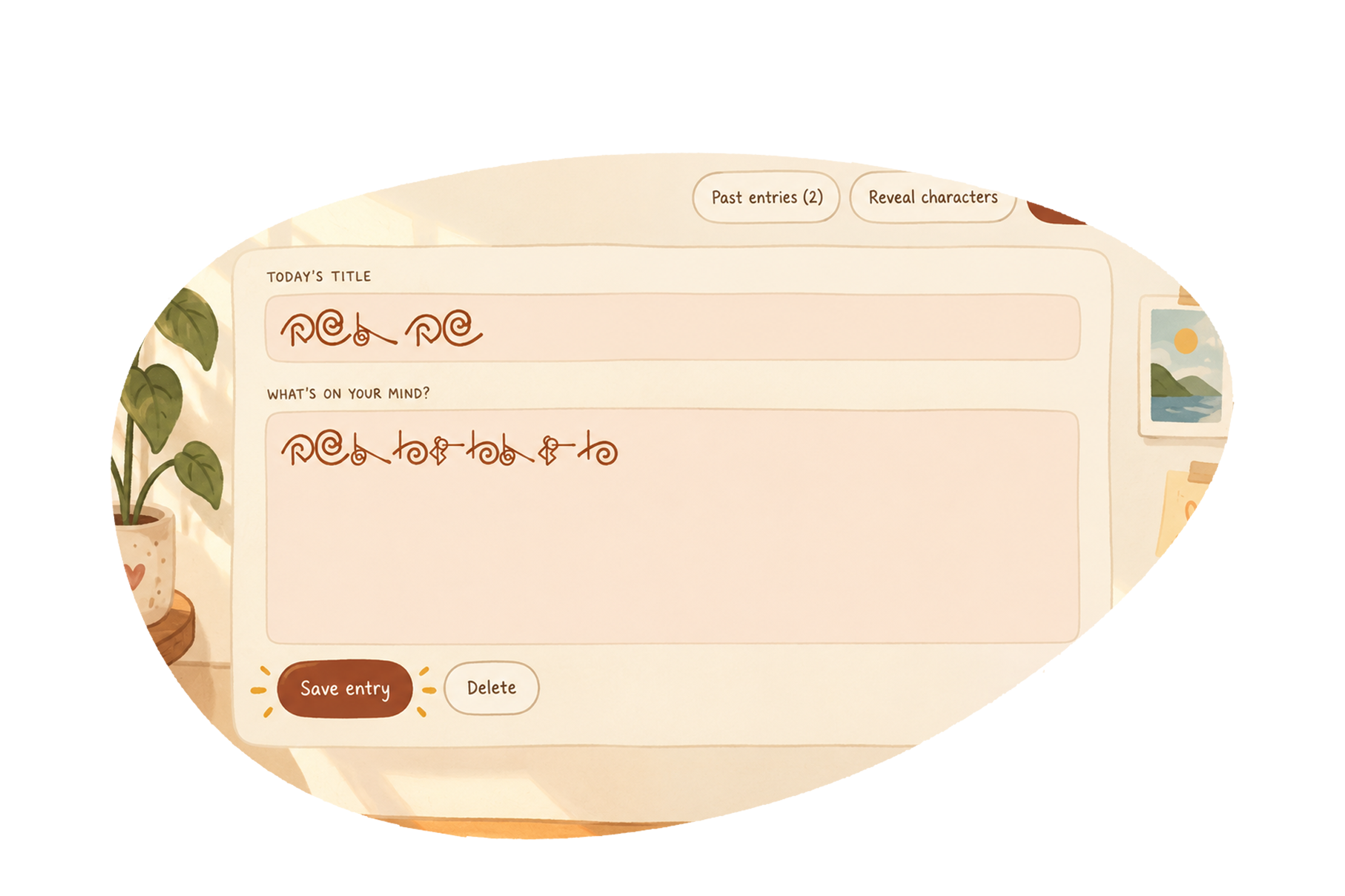
Type any thought into the quiet box to observe how your personal script can obscure and preserve vulnerability.
Asemic Translation
Philosophy of the Quiet Desk
Pillar 01
Marks before rules. Draw freehand, lift glyphs from your pages, or lean on a soft reference. Cadence, weight, and rhythm lead. Meaning can wait.
Pillar 02
Glance-proof on the page. Encrypted before it leaves your browser. Kept where only you can open it. We cannot read what’s inside.
Pillar 03
Practice until the shapes settle.While journaling, reveal Latin for a moment if you get stuck, then let it fade. The mapping stays yours.

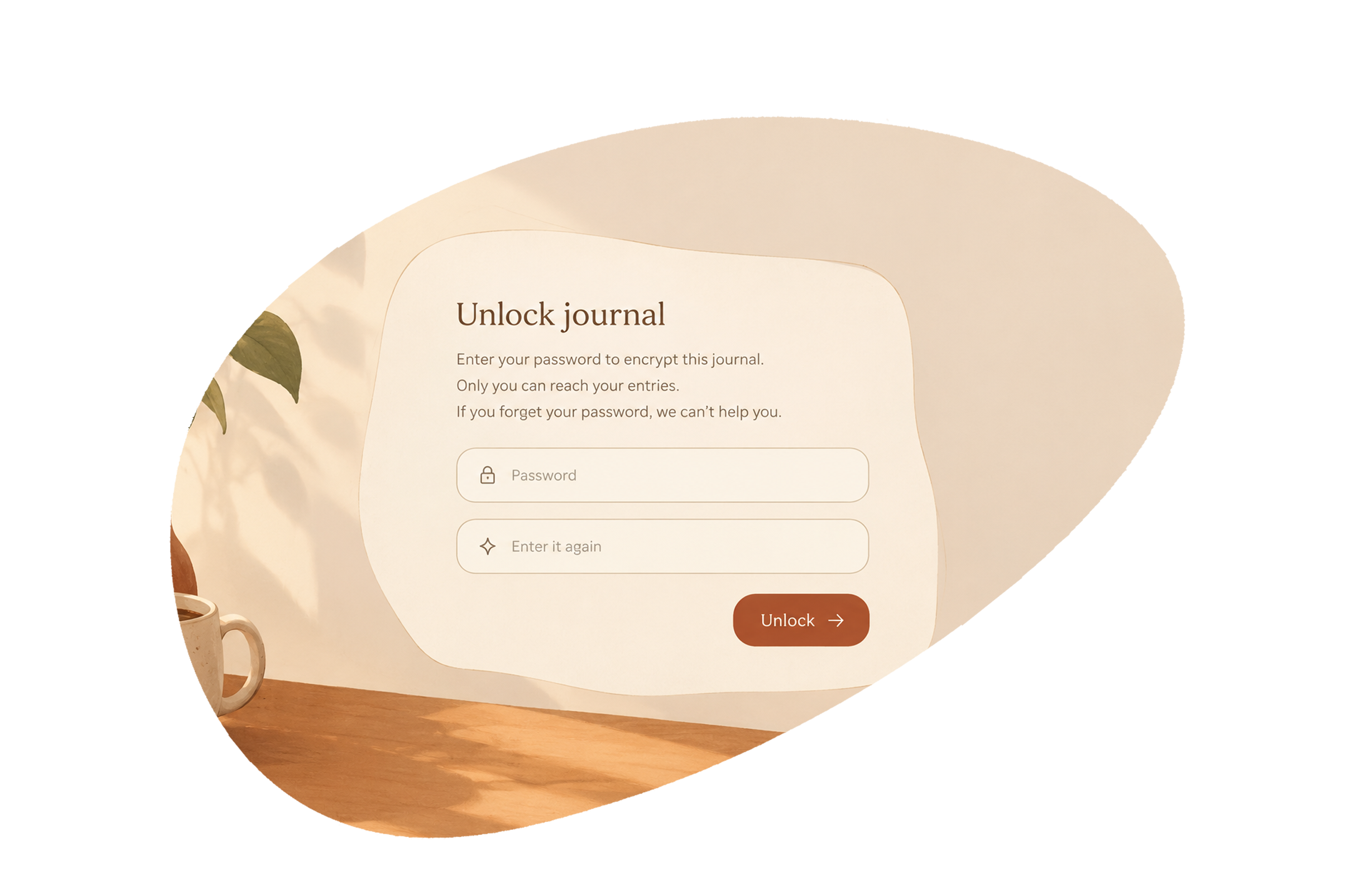
We provide military grade encryption for every user. Our team can’t read what’s inside.
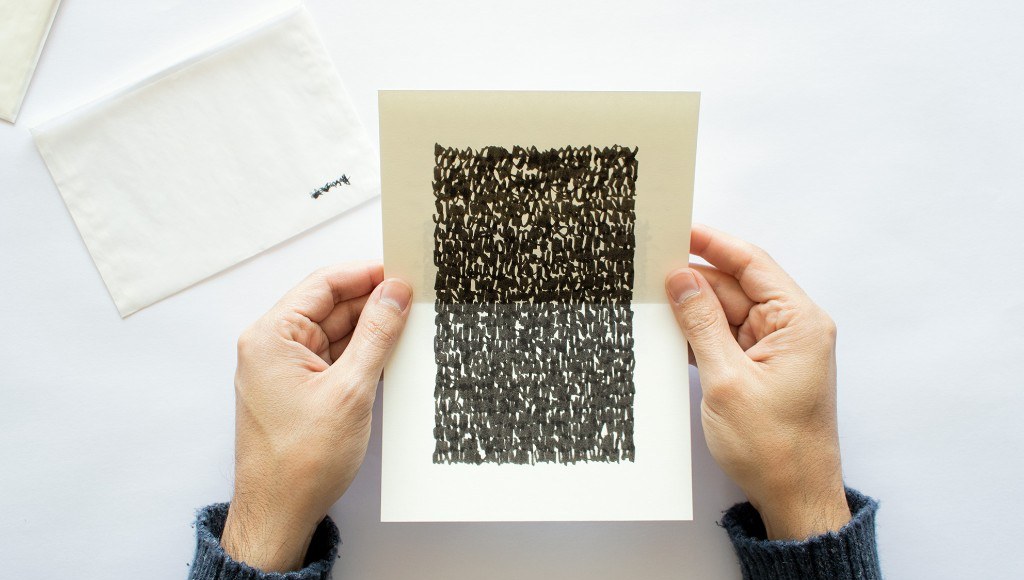
An asemic writing journal starts before the sentence.
Read story
What would change if you met yourself on the page for a few minutes each day?
Read story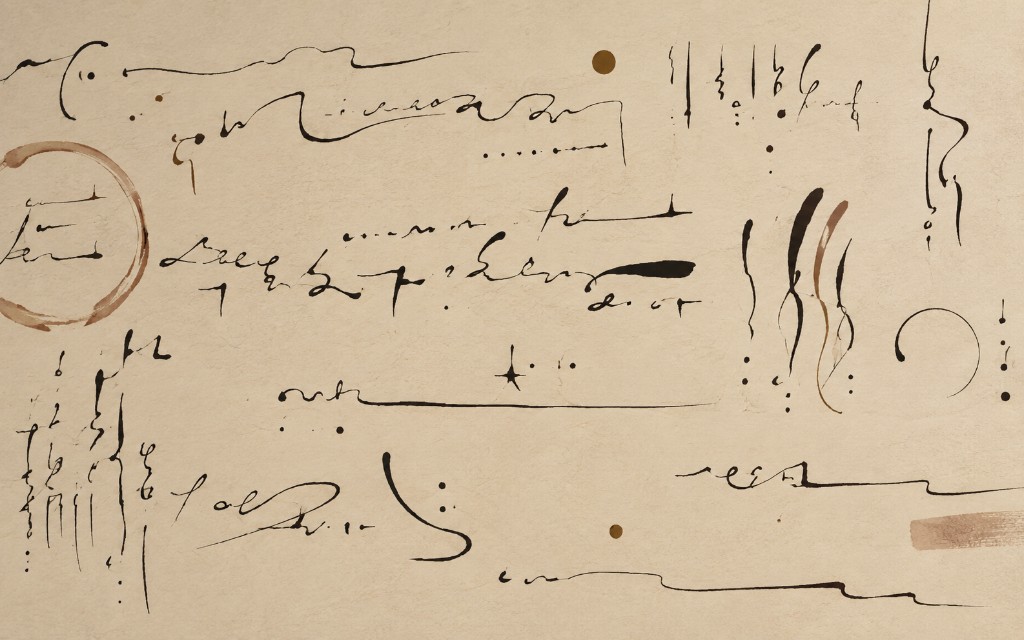
What if your hand could speak before your words catch up?
Read storyAn asemic writing journal starts before the sentence.
Read story
What would change if you met yourself on the page for a few minutes each day?
What if your hand could speak before your words catch up?
Last updated: 30 September 2026
This notice explains what the operator of youish (“youish”, “we”, “us”) collects when you use youish.app, why we collect it, and the choices you have. It covers the journal, the letter workshop, practice, stories, and the contact page.
youish is a private journal for signs you invent. We do not take payment. Questions about this notice go to info@youish.app.
Account. When you create an account we store your name, email, a hash of your account password, and the time you last signed in. We do not store the account password itself. We cannot show it to you. If you forget it, write to us from that email and we can help you set a new one.
Journal. The journal is private to your account. We do not publish it, and other accounts cannot open it. There is no control that makes an entry public or visible to a search engine.
The journal password is separate from the account password. You create it in your browser and enter it twice. We do not receive that password, and we do not keep the key that opens the journal. The key stays in memory on that device only until you leave or refresh.
Until you create the journal password, the title and text of an entry are stored so your account can load them. After you create it, the title and text are encrypted in the browser with AES-256-GCM before they are saved. We store that encrypted text and the wrapped key material your browser needs to open it with the journal password. We cannot read it. If you forget the journal password, we cannot open the entries. There is no recovery code. A request from you, from support, or from a government cannot produce the title or the text, because we do not have the key.
Some fields stay outside the encrypted text so the journal can still be organised: tags, the time an entry was created or updated, alignment, line spacing, and letter spacing.
Letter workshop and practice. Letter maps, glyphs, fonts you generate, the reference style you select, practice progress, ink colour, text size, and keyboard layout are stored with the account. The journal password does not lock them. Uploaded sheets stay in this browser. They are not copied into the account.
Contact. A message from the contact page, or an email to info@youish.app, includes your name, an email if you give one, and the message. We keep it so we can read it and reply. It is not added to your journal, and it is not encrypted as a journal entry.
We do not collect payment card numbers. We do not offer sign-in with Apple or Google. We do not ask for your contacts, precise location, motion, or fitness data.
The site loads a Google tag. Google may receive technical information about the visit, such as the page address, browser, and device data, and may use cookies. We use that to understand how the site is used. We do not send your journal text, letter maps, or passwords to Google, and we do not combine the tag with your journal. Google’s use of that information is governed by Google’s policies: https://policies.google.com/privacy.
Our hosting provider may keep short technical logs of a request, such as an IP address, browser type, and the time of the request, so the site can run and so problems can be investigated. Those logs are not your journal.
This browser stores your session and your uploaded sheets on the device, using the browser’s own storage. Clearing the site data in the browser removes the sheets from that device.
You can set the browser to refuse cookies. The journal still works. Measurement of visits may not.
We use this information to:
We do not sell personal information. We do not share it for cross-context behavioural advertising. We do not send marketing email. We do not read a locked journal, and we do not ask you to paste a journal entry into a support message.
When you generate signs, the drawing you submit is sent to Replicate so Flux can finish that job. We do not send your journal, your email, or your passwords. Replicate may process the image outside your country, including outside the European Economic Area. The drawing is used to finish that job. We do not keep it next to your email.
Your journal is not processed by an AI model. We do not use journal titles, journal text, letter maps, or glyphs to train a language or image model. A generated sign is not promised to be unique. It may resemble a known letter or someone else’s mark.
We share information only in these cases:
We do not sell information to advertisers, data brokers, or other apps. Information that cannot reasonably identify you may be used to understand the service.
If the GDPR, UK GDPR, or a similar law applies to you, we use your information on these grounds:
Account data is stored by our hosting and database providers. Those providers may be outside the country where you live. Encrypted journal text is stored as ciphertext. Sheets stay on your device. Drawings for sign generation are processed by Replicate. Visit data from the Google tag is processed by Google.
If you are in the EEA, the United Kingdom, or Switzerland, you can ask us at info@youish.app which safeguards apply when information leaves your country.
The account, journal, letter maps, glyphs, fonts, practice progress, and last sign-in time stay until you delete the account. We do not keep them for a marketing list. Sheets stay on this device until you clear them or delete the account. Contact messages stay so we can read them and reply. You can ask us to delete a contact message.
Delete account removes your account and saved work from the account store. There is no recovery window after that. A backup held by a hosting provider may remain for a short time under that provider’s backup cycle, then drop out of it. We do not use a backup to restore an account you deleted, unless a legal duty requires us to keep a record. A locked journal is deleted as ciphertext. Deletion does not decrypt it.
Technical logs are kept only as long as the host needs them to run and protect the service, and then discarded.
No online service is perfectly secure. We take reasonable care to protect information against unauthorised access, loss, and alteration. The journal lock is the stronger protection: after you set the journal password, the title and text are encrypted in your browser, and we do not hold the key. You are responsible for that password.
While you are signed in, Delete account on this page removes the account data we store: email, letter maps, glyphs, fonts, practice progress, and the journal. It also clears the sheets saved on this device.
You can refuse cookies in your browser. You can ask us to delete a contact message. We do not send marketing email, so there is no marketing list to leave.
Depending on where you live, you may have the right to access personal data we hold, correct it, delete it, restrict or object to some uses, and receive a portable copy of what we hold. You may also complain to a data-protection authority. In the EEA, a list of authorities is at https://edpb.europa.eu/about-edpb/board/members_en. In the United Kingdom, the authority is the ICO: https://ico.org.uk/global/contact-us/. In Switzerland, it is the FDPIC: https://www.edoeb.admin.ch/edoeb/en/home/the-fdpic/contact.html.
After the journal is locked, a copy we can give you of the title and text is still ciphertext. We cannot turn it back into writing.
In some US states, including California, Colorado, Connecticut, Utah, and Virginia, you may also ask for the categories of personal information we collect and the categories of third parties we share it with, and you may appeal a refusal. We do not sell or share personal information as those laws define those words. We do not knowingly sell or share the personal information of anyone under 16. We do not use sensitive personal information to infer characteristics about you.
The personal information we collect, depending on what you use, falls into these categories: identifiers such as name and email; information you create, such as a journal, glyphs, and letter maps; internet or device activity from the Google tag and host logs; and images you submit to generate signs. Sources are you, your browser, and those providers. We use and keep the information as this notice describes.
To use a right, email info@youish.app from the email on the account, or use the Contact page. We need to know the request is from the account holder before we disclose or delete anything. You may name someone to ask for you if you give us written permission. We will say yes or no in writing. If we say no, you can reply and ask for an appeal. Someone who did not handle the first request will review it. If the appeal is also refused, we will tell you, and in some US states you can take that refusal to the state attorney general.
We will not ask you for the journal password, and a privacy request cannot open a locked journal. We do not treat you differently for asking.
youish is not directed at children. The age to create an account is the age where you live. We do not open an account for anyone under 13, in any country.
If the law where you live requires an older age than the one listed, that older age applies. If you are under 18, a parent or legal guardian must agree to the terms and to this notice for you, including where the privacy age above is 13, 14, or 15. The UK Children’s Code and similar rules treat anyone under 18 as a child.
If we know that an account belongs to someone under the age for their country, or to someone under 18 whose parent or guardian has not agreed, we close the account and delete the personal data we hold for it. In the United States, COPPA applies under 13. California and some other states add limits on selling or sharing data about people aged 13 to 15 and, in some laws, under 16 or under 18. We do not sell or share that data.
We may update this notice. The date at the top will change. If a change is significant, we will also show a notice in the service when we reasonably can. Continuing to use youish after the update means the new notice applies. If you do not agree, stop using the service and delete your account.
Email info@youish.app, or use the Contact page.
Last updated: 30 September 2026
These terms are a binding agreement between you and the operator of youish (“youish”, “we”, “us”). They cover the website at youish.app, including the journal, the letter workshop, practice, stories, and the contact page. By creating an account, signing in, or using the site, you agree to these terms and to the Privacy notice. If you are under 18, your parent or legal guardian agrees to them for you. If you do not agree, do not use the service.
youish is a private journal that uses signs you invent. You can draw or upload a sheet, choose a reference style, generate signs, keep glyphs, map them to letters, practise them, and write journal entries. You can add tags and set the alignment and spacing of an entry. Stories on the site are written by youish. They are part of the site, not part of your journal.
The service is free. We do not sell products, take payments, or run a shop. If we ever charge for a feature, we will say so before you pay, and we will update these terms first.
We may change, limit, or stop features. We cannot promise that every version of the site will stay online.
youish is a private journal. It is not directed at children, and it is not a social product for minors. The age to create an account follows the country where you live. We do not open an account for anyone under 13.
These are the minimum ages we apply. They follow the local age for consent to this kind of data use:
For a country that is not listed, the minimum is 16, unless that country has set a different age by law. If the law where you live requires an older age than the one listed, that older age applies.
A person under 18 cannot agree to these terms alone. That rule is separate from the ages above, and it applies in every country, including where the privacy age is 13, 14, or 15. The UK Children’s Code, and similar age-appropriate design rules, also treat anyone under 18 as a child. If you are under 18, you may use youish only if a parent or legal guardian has read these terms and the Privacy notice and agreed to them on your behalf. Creating an account while you are under 18 is your confirmation that they have done so.
In the United States, COPPA applies under 13, which is why the United States is in the 13 group. California and some other states add duties for teenagers, including limits on selling or sharing personal information of people aged 13 to 15 and, in some laws, under 16 or under 18. We do not sell personal information, and we do not share it for cross-context behavioural advertising.
If we know that a person is under the age for their country, or is under 18 without a parent or guardian who agreed, we close the account and delete the personal data we hold for it. A sentence in these terms does not allow us to keep the account after we know.
When you register, you agree to give a real name and a real email address, keep them accurate, and keep the account password to yourself. The account password needs at least 6 characters. We store a hash of it. We cannot show it back to you. If you forget the account password, write to us from that email and we can help you set a new one.
You are responsible for activity under your account. Tell us, through the contact page, if you believe someone else is using it. Do not use another person’s account, and do not share yours.
The first time you open the journal, you create a journal password and enter it twice. It needs at least 6 characters. It is a password for the journal. We do not receive it. The key that opens the journal is created in your browser and stays in memory only for that visit. When you leave or refresh, the journal locks again.
After you create that password, the title and text of each entry are encrypted in the browser before they are saved, using AES-256-GCM. We store the encrypted text and the wrapped key material needed for your browser to open it with that password. We do not have the key. We cannot read the title or the text. If you forget the journal password, the entries cannot be restored. There is no recovery code, and support cannot unlock them.
Until you create the journal password, the title and text are stored so the account can load them.
Tags, creation and update times, alignment, line spacing, and letter spacing are saved with the entry and are not inside the encrypted text. Letter maps, glyphs, fonts, practice progress, and display settings are saved with the account and are not covered by the journal password. Uploaded sheets stay in your browser and are not copied into the account.
You are responsible for remembering the journal password and for keeping any copy of your writing that you need. If we discontinue the service, we cannot decrypt a locked journal for you.
You keep ownership of your drawings, glyphs, letter maps, fonts you generate for yourself, and journal entries (“your content”). We do not claim ownership of your content.
You give us a limited licence to host, store, back up, and transmit your content only so we can operate the service and show it back to you. For a locked journal, that licence is to store and return the encrypted text. It is not a licence to read the title or the writing. The licence ends when the content is deleted, except for a short-lived provider backup described in the Privacy notice, or a copy we must keep to meet a legal duty.
Generated signs are for your use in youish: the journal, practice, and the letter map. We do not promise that a sign is unique, original, or free of resemblance to a known letter or to someone else’s mark. Generation can fail, and a result can differ from the reference you chose.
You are responsible for your content. You confirm that you have the rights you need to upload it, that it does not infringe anyone else’s rights, and that it complies with these terms and with the law that applies to you.
You agree not to use youish to:
We may remove content and suspend or close an account that breaks these rules.
The site, its design, the youish name, the stories we publish, and the software that runs the service belong to us or to our licensors, and are protected by intellectual-property laws. Your content is excluded.
We give you a limited, personal, non-exclusive, non-transferable licence to use the site for your own private journaling. You may not copy the service, resell it, or present it as your own product. You may not reverse engineer it except where the law expressly allows that. You may not use the youish name or marks as the name of another product without written permission.
Sign generation sends your drawing to Replicate (Flux). Replicate’s terms apply to that step. We do not send your journal, your email, or your passwords to Replicate.
The site loads a Google tag so we can understand visits. Google’s terms and privacy rules apply to that tag. We do not send your journal text or your passwords to Google.
We are not responsible for a third-party site or tool that you open from youish, or for the availability of Replicate or Google. Links, if we show them, are there for convenience.
How we handle personal data is described in the Privacy notice. That notice is part of the agreement between you and us. Where these terms and the notice describe the same fact, they are meant to be read together. The journal-password rules in these terms control if a sentence elsewhere is older.
The service, including generated signs and the journal lock, is provided “as is” and “as available”. To the fullest extent allowed by law, we disclaim warranties of merchantability, fitness for a particular purpose, satisfactory quality, quiet enjoyment, and non-infringement, and any warranty that the service will be uninterrupted, error-free, or secure, or that a defect will be corrected.
We do not warrant that generation will succeed, that a sign will match a style, or that a locked journal can be opened without the journal password. We take reasonable care with the service. That care is not a promise that encryption, storage, or transmission is perfect.
Some countries do not allow an exclusion of this kind. In those places, the exclusion applies only as far as the law allows, and statutory rights stay in force.
To the maximum extent allowed by law, we are not liable for indirect, incidental, special, consequential, or punitive loss, or for loss of data, profits, or goodwill, arising from your use of the service or from your inability to use it. This includes a journal that cannot be opened because the journal password is lost, and a drawing or sign that is lost because a provider fails.
Where a cap is allowed, our total liability for a claim arising from these terms is limited to the amount you paid us for the service in the 12 months before the claim. The service is free, so that amount may be zero.
Nothing in these terms excludes or limits liability for fraud, for death or personal injury caused by negligence, or for any other liability that the law does not allow us to exclude or limit. If you are a consumer, mandatory consumer rights in your country of residence remain in force.
To the extent the law allows, you agree to cover claims, losses, and reasonable legal costs brought against us because of your content, your use of the service, or your breach of these terms or of someone else’s rights. This does not apply to the extent the claim is caused by our own breach, and it does not take away rights a consumer cannot waive.
You may delete your account at any time from the Privacy page while you are signed in. Deletion removes the account and the saved journal, letter maps, glyphs, and fonts from the account store, and clears sheets stored in that browser. A locked journal is deleted as ciphertext. Deleting the account does not decrypt it, and it does not create a copy for you.
We may suspend or close an account if you break these terms, if the law requires it, or if we discontinue the service. When we reasonably can, we will tell you. If the law requires us to act immediately, we may not be able to tell you first. If we close an account because you broke these terms, and a paid feature exists at that time, fees already paid are not refunded except where the law requires a refund.
We may update these terms. The date at the top will change. If a change is significant, we will also show a notice in the service when we reasonably can. Continuing to use youish after the update means you accept the new terms. If you do not agree, stop using the service and delete your account.
If a court or authority finds that a sentence in these terms is invalid or cannot be enforced where you live, that sentence is limited or removed there. The rest of the terms stay in place. We will treat the invalid sentence as replaced by the closest valid rule that still matches what the sentence was trying to do.
These terms and the Privacy notice are the whole agreement between you and us about the service. They replace earlier understandings about the same subject. If we do not enforce a term once, that is not a waiver of the right to enforce it later. You may not transfer your account or these terms to someone else. We may assign them to a successor that continues the service, and we will tell you if that happens.
These terms apply wherever you use youish. They do not replace mandatory laws in the country where you live, including consumer, privacy, and data-protection rules that cannot be waived. Those rules stay in force. Please contact us and give us a reasonable chance to resolve a dispute directly before you start a formal claim.
Questions about these terms: info@youish.app, or the Contact page.
You can either draw your glyphs, use asemic sheets to generate them or take a reference from library.
Begin with sensation, rhythm, and movement. Make marks first. Let meaning come later.
Asemic writing looks like writing, but it has no shared way to read it. No correct alphabet. No spelling to fail. No structure you must obey. Every stroke belongs.
Use this practice to loosen your hand and find shapes that feel like your own. Over time, you can give those shapes personal meanings and grow a private script for journaling. Others may see the marks. Only you will know how to read them.
Borrow the movement, not the shapes. Then begin creating a script that belongs only to you.
Free marks, not letters. Best with a finger or stylus — a mouse will feel stiff. Leave a little air between clusters if you want more shapes.
Tap a shape, then a letter below. You can keep writing if you want more.
Pick one style. Create Glyphs uses that archetype as the reference.
Up to 3 pages.
Drag a glyph to a letter, or back here.
0 of 26 letters assigned
Pair each Latin letter with the glyph you made for it.
Inscribe glyphs, then drill them here.
Save an alphabet first, then these drills become your private crib.
Make my alphabetDraw the stroke from muscle memory. Feel the rhythm before the intellect names it.
Draw the mark for A
A word is written in your alphabet. Type what you read.
Make an alphabet first, then this page turns into your journal.
Make my alphabetYou can continue with your sheet or select one archetype as a reference.